For a lot of panoramas a head is just not necessary. It only becomes important when there are things close to the camera. If the camera is not rotated around the correct point then the foreground objects move relative to the background and stitching becomes difficult or impossible. This is were the Panoramic Head comes in. Unfortunately they are expensive, bulky and heavy. Even if you can afford the price tag, there will be many occasions when you will come across a great panorama opportunity and wont have the head. It is possible to improvise by using a weight hanging on a piece of string tied around the lens at the correct point like a plumb line. Make a mark on the ground and check that the weight is directly over the mark for every shot. This is a pain in the arse, but it does work. It can’t be done quickly and that limits the panoramas that can be successfully taken.
There is an easier method.
It involves finding a stable point to rest on. A fence post might do the job. Or a tripod. Hold the camera in such a way that one of your left hand knuckles is directly under the correct point on the lens. Rest the knuckle on the pivot point and rotate the camera on it as you take the shots. This is obviously not as accurate as a Panoramic Head, but it seems to be accurate enough to do a good job. This is the shot taken using my bedpost as a pivot.
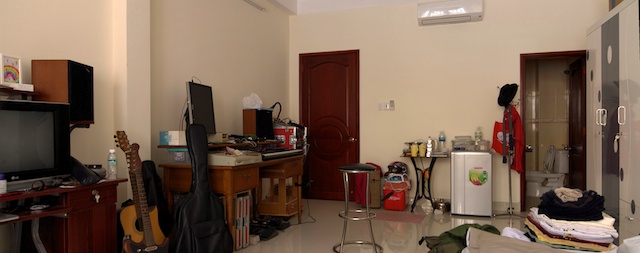
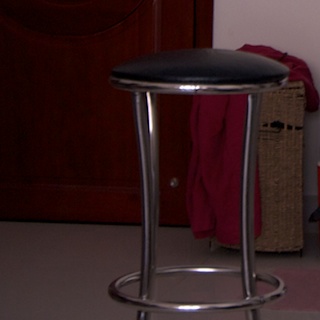
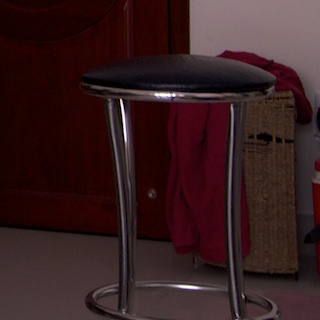
The stool in the centre of the picture lines up quite nicely with the door behind it and stitching was very straightforward. Here are parts of the individual photos where I would normally expect problems. You can see that the stool and the washbasket line up quite nicely
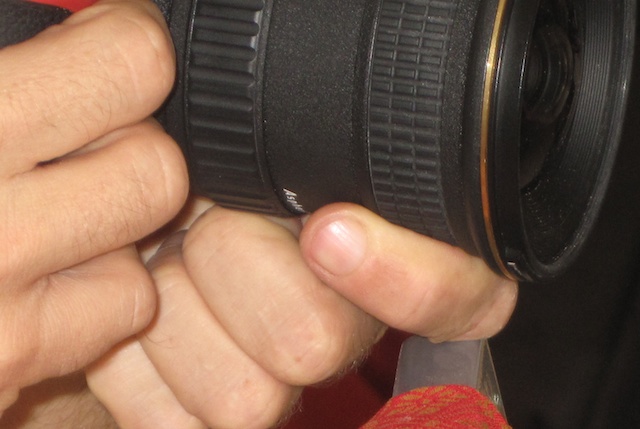
Holding the lens
The ring under my finger is the focus ring for this lens. It slides to switch between manual and automatic focus, and I have mine set on automatic focus. This means that any accidental movement of the ring has no effect on the lens settings. In case you are wondering, it’s a Tokina 12-24. This mechanism seems to be common on Tokina lenses. You may need to be careful not to inadvertently adjust zoom or focus with other lenses.
Finding the correct point to rotate around
This point is dependant on the lens (and its zoom setting if it isn’t a prime). You may be able to find the information for your lens on the net, or you can work it out by taking pictures and adjusting the rotation point until objects in the foreground and the background stay in the same relative positions. Or you can do what I did and guess. It is likely to be just a little behind the front of the lens.
Note that “the correct point” does have a name. In fact it has several, and there is a lot of pointless argument about what that name is or should be. I welcome comments on this post concerning anything else except the correct name for this point 🙂